Operational systems for the next industrial age.

I’m Justin Thompson. I build the software that runs a physical business: production scheduling, product catalogues, inventory, and the reporting around them, with AI where it earns its place. Thirteen years inside manufacturing and ecommerce. Saskatoon, Canada.

Demand forecast

simulated data

80100120140160units / day−10w−6w−2wnow+2w+4wcapacity
  • Observed demand
  • Forecast mean
  • Possible futures
  • Capacity
Forecast horizon
28 days
Breach within 7 days
75%
80% interval
±5%
Simulated demand with a 28-day probabilistic forecast: 96 possible futures against a fixed capacity line. The same kind of model sits behind systems 02 and 04.

01 · Work

Four systems, built around real operational constraints.

Four systems from real operations, generalized for public reading. Each started with how the work actually happens, not with a technology.

Floorline

Production Control Layer

The daily operating system for a production floor.

Problem
Jobs, due dates, and status lived in separate tools and in people’s heads, so every handoff needed a conversation.
System
One place to plan the queue against capacity, see the state of every job, flag exceptions to the right people, and refresh the numbers each morning on their own.
Result
Coordination moved from conversations to a shared board. Managers plan from the same view the floor works from.

My roleProblem framing · Workflow and product design · Architecture · Implementation · Testing and rollout

Work flows through planning, execution, verification, and reporting; feedback returns to the start.

Lifecycle

Product Lifecycle Intelligence

Decision support for a large ecommerce catalogue.

Problem
Deciding what to keep, discount, or retire meant pulling sales, inventory, and margin out of several systems by hand, and the answer changed with who did the pulling.
System
A review layer that scores every product on velocity, sell-through, and stock, runs the heavy analytics in the background, and routes decisions through structured approvals.
Result
Reviews happen on a schedule with the same evidence every time, and the app stays fast because the analysis never runs on the page.

My roleDecision model · Workflow and UX · Data architecture · Cloud implementation · Production hardening

Monitoring, review, action, and archive turn around one human decision.

Human gate

AI-Assisted Product Creation

Human-in-the-loop setup for new ecommerce products.

Problem
Every new product meant reading mockups and spec sheets, then typing the same details into the store, variant by variant.
System
Vision models and deterministic rules read the inputs and produce complete, validated product records. A person reviews each one before anything reaches the store.
Result
Setup turned from a chore into a review. People spend their time on the judgment calls, and nothing publishes without approval.

My roleWorkflow model · Product and UX · AI and rules design · API architecture · Acceptance and verification

Inputs are interpreted by rules and a model, then held for a person before anything is published.

Risk field

Inventory Risk Intelligence

Which empty shelves actually cost money.

Problem
A stock report lists every variant at zero without saying which ones matter.
System
A daily model estimates the sales lost to each stockout from that variant’s own history, then ranks the gaps into an auditable queue.
Result
The restock conversation starts with the biggest losses instead of the longest list.

My roleBusiness logic · Forecasting model · Data architecture · Decision UX · Reliability and boundaries

Demand, supply, and context are ranked into a queue that reorders as the picture changes.

02 · Capabilities

Six disciplines, one implementation loop.

One loop, from how the work runs to a system that runs reliably. Each discipline shows up in the systems above.

Operational systems

Workflows modeled on how the work actually happens: states, handoffs, capacity, exceptions, and the rollout that gets people using them.

Process mapping, State machines, Capacity planning, Exception design, Rollout + training

Product + UX

Screens for people under pressure: review flows, clear ownership, and decision surfaces that stay legible on a busy floor.

Information architecture, Interaction design, Review workflows, Role + authority design, Operational visualization, Full-stack React + TypeScript

Data + intelligence

Pipelines, forecasts, and read models built for decisions, with freshness and uncertainty kept in view.

PostgreSQL + SQL, BigQuery, Python + Pandas, ETL / ELT, Forecasting, Cache + read models

AI + automation

Rules plus models where they help, human approval where it matters, and one source of truth throughout.

Multimodal vision models, Document + image extraction, Deterministic rules, Human-in-the-loop gates, Codex + Claude workflows, OpenClaw orchestration

Cloud + reliability

Thin apps on top of scheduled and on-demand compute, scoped access, monitored jobs, and failure paths that recover.

Cloud Run jobs + services, Cloud Scheduler, BigQuery + Cloud Storage, Queues + retries, IAM + Secret Manager, Health + monitoring, Migrations + rollback, Playwright + pytest

Commerce + integrations

Store, inventory, workspace, messaging, and reporting systems connected into one controlled workflow.

Shopify GraphQL + REST, Google Workspace, Slack, Webhooks + APIs, OAuth, Operational reporting

03 · Approach

The build starts before the code.

AI makes the build faster. Deciding what to build, how it fits the operation, and whether it is safe to ship stays with me.

  1. Observe the work

    Sit with the real workflow: the handoffs, the failure modes, the incentives.

  2. Define the control model

    Make states, ownership, data, and exceptions explicit before anything is built.

  3. Build the shortest useful loop

    Ship the narrowest thing that works, instrument it, and watch real use.

  4. Harden and extend

    Automate what has proven itself, make it reliable, and move heavy work to the right infrastructure.

04 · About

Close enough to the work to know where software breaks.

I came to software from the floor, not from a computer science program. Before that I framed houses and tested oil and gas wells.

For thirteen years I have worked inside a manufacturing and ecommerce business: scheduling production, managing inventory, reading demand, fixing handoffs, and noticing where spreadsheets, systems, and judgment stop lining up. Along the way I did the same for a multi-location field-services company. Now I build the systems I used to wish for.

Based in
Saskatoon, Saskatchewan
Studied
Business Economics (Honours), University of Saskatchewan
Field
Manufacturing and ecommerce
Works in
Operations, data, and AI
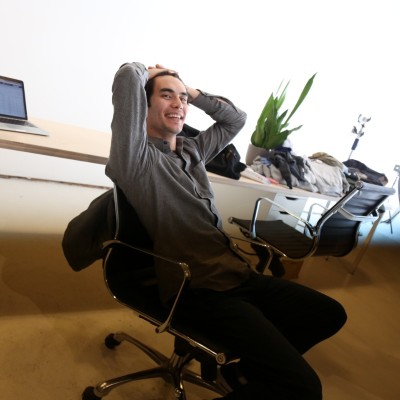
Justin Thompson seated in a studio workspace
Dark album artwork with mirrored angular figures drawn in fine red lines

05 · Outside the work

The Basement Paintings

Long-form instrumental music with a Saskatchewan ambient/post-rock band, since 2011. Collaboration, patience, and scale, practised for a long time.

  • Saskatchewan Music Awards Metal/Loud Artist of the Year (2020)
  • Western Canadian Music Award nominee, loud/heavy category (2020)
  • BreakOut West official showcase (2022)

“Future Describer” began as a song title on our first album before it became my online name.

thebasementpaintings.com (opens in a new tab)

06 · Contact

Have an operation that needs better software?

I take on a few systems, analytics, and automation projects at a time, the kind where real operations and software have to meet.